Buy Now & Pay Later Options Available – Learn More

Shipping Container Dimensions – Complete Size Guide

Understanding shipping container dimensions is crucial for efficient transport, storage, and project planning. Whether you’re importing goods, setting up a container home, or sourcing space for your business, getting the right size container matters. In this guide, we’ll break down standard container specs in Australia, including 20ft and 40ft variations, internal and external dimensions, and capacity details—complete with a downloadable chart and FAQ section. 

What Are the Standard Shipping Container Sizes?

Shipping containers come in a few key standardised sizes, based on ISO 668 international standards. The most commonly used sizes include: 

  • 20ft General Purpose (GP) 

  • 40ft General Purpose (GP) 

  • 40ft High Cube (HC) 

These sizes are widely used across Australia for freight, construction, modular buildings, and portable storage. They are compatible with rail, road, and sea transport, making them incredibly versatile. Container manufacturers adhere strictly to ISO regulations to ensure all units can be handled uniformly with cranes, forklifts, and locking mechanisms. Whether you need to understand the internal dimensions of a shipping container or assess external height and payload, standardisation makes comparing and planning much easier. 

What Are the Dimensions of a 20ft Container?

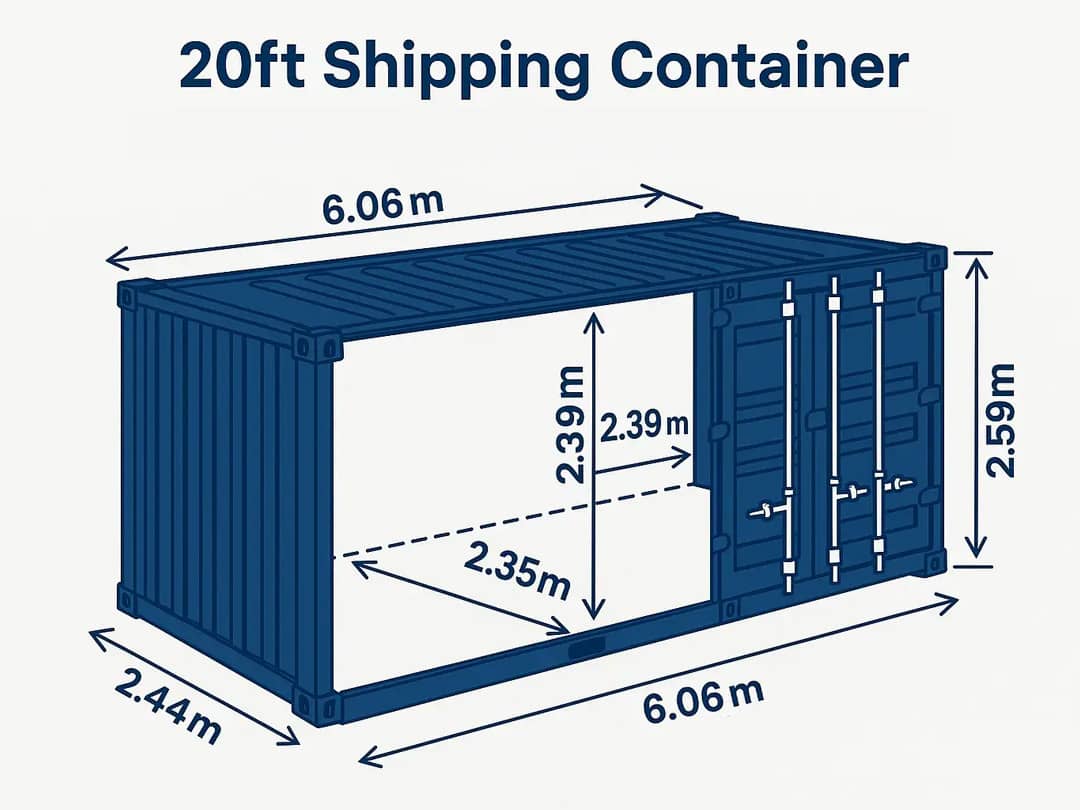
20ft shipping container dimensions

If you’re looking for 20ft shipping container specs, here’s what you need to know: 

External Dimensions 

The external measurements for a standard 20ft GP container are: 

Length Width Height
6.06 metres 2.44 metres 2.59 metres

These dimensions allow easy integration with shipping infrastructure, including stacking and locking mechanisms. 

Internal Dimensions 

These internal dimensions of a shipping container provide approximately 33 cubic metres of usable space, making it suitable for small-scale storage and transport. Always verify the internal space if using pallets, as these affect layout and load. 

Weight

Length Width Height
5.90 metres 2.35 metres 2.39 metres
Tare Weight Max Gross Weight Payload
~2,200 kg ~30,480 kg ~28,280 kg

 The tare weight refers to the container’s own weight, while payload refers to the maximum cargo weight it can safely carry. 

Capacity (Cubic m³) 

  • Volume: ~33 m³ 

This volume is ideal for transporting around 10 standard pallets, depending on configuration. 

What About 20ft High Cube Specs?

While less common than their 40ft counterparts, 20ft High Cube specs provide added height in a compact footprint. 

Category Specification
External Dimensions
Length6.06 metres
Width2.44 metres
Height2.89 metres
Internal Dimensions
Length5.90 metres
Width2.35 metres
Height2.69 metres
Weight & Volume
Tare Weight~2,350 kg
Volume~37 m³

40ft Container Dimensions (Standard & High Cube)

The 40 ft container dimensions are ideal for transporting bulkier or more extensive cargo and are also commonly used in container homes and modified structures. 

40ft General Purpose (GP)

Category Specification
External Dimensions
Length12.19 metres
Width2.44 metres
Height2.59 metres
Internal Dimensions
Length12.03 metres
Width2.35 metres
Height2.39 metres
Weight & Volume
Tare Weight~3,700 kg
Max Gross Weight~30,480 kg
Payload~26,780 kg
Volume~67 m³

This type can hold up to 21 standard pallets and is excellent for long-distance freight across container dimensions Australia standards.

40ft High Cube Container Dimensions

Category Specification
External Dimensions
Length12.19 metres
Width2.44 metres
Height2.89 metres
Internal Dimensions
Length12.03 metres
Width2.35 metres
Height2.69 metres
Weight & Volume
Tare Weight~3,900 kg
Volume~76 m³

The extra 30 cm of internal height is useful for transporting taller items or building modular homes. If you’re after more headspace, the height of a shipping container in the High Cube model delivers. 

These are ideal for taller equipment, stacked pallets, or residential applications with ceiling height preferences. 

How Much Does a Shipping Container Weigh?

The weight of a shipping container depends on its size and type: 

Container Size Type Tare Weight
10ftGeneral Purpose~1,300 kg
10ftHigh Cube~1,450 kg
20ftGeneral Purpose~2,200 kg
20ftHigh Cube~2,350 kg
40ftGeneral Purpose~3,700 kg
40ftHigh Cube~3,900 kg
45ftGeneral Purpose~4,600 kg
45ftHigh Cube~4,800 kg

These are tare weights (unloaded). Always check the container’s CSC plate for the exact specs, especially for payload and maximum gross weight. Shipping container weight affects freight charges, so knowing exact figures is essential for budgeting. 

Which Shipping Container Size Is Right for You?

Here’s a quick guide based on use case: 

  • 20ft Container: Ideal for small businesses, equipment storage, relocations, and sites with space constraints. 
  • 20ft High Cube: Great when you need extra vertical space but not a full 40ft footprint. 
  • 40ft GP Container: Suits bulk storage, long-haul transport, and building conversions. 
  • 40ft HC Container: Best for large volume cargo or projects requiring added height (e.g., modular buildings). 

Consider the following when choosing a container: 

  • Site Access: Ensure space for delivery truck manoeuvrability. 
  • Height Restrictions: Consider bridges, overpasses, and site entry. 
  • Weight Limits: Check regional transport regulations for loaded container weights. 

Still not sure? Check out our 20ft container and 40ft container pages for more details. 

Shipping Container Dimensions Chart (Downloadable)

Download a complete ISO container size chart for logistics, freight, and storage planning. Includes both standard height and high cube options for all container lengths.

Container Type External (L×W×H mm) Internal (L×W×H mm) Max Gross (kg) Tare (kg) Max Payload (kg)
10' Standard2,991 × 2,438 × 2,5912,831 × 2,352 × 2,37610,1601,3008,860
10' High Cube2,991 × 2,438 × 2,8962,831 × 2,352 × 2,69810,1601,4508,710
20' Standard6,058 × 2,438 × 2,5915,898 × 2,352 × 2,39330,4802,20028,280
20' High Cube6,058 × 2,438 × 2,8965,898 × 2,352 × 2,69830,4802,40028,080
40' Standard12,192 × 2,438 × 2,59112,032 × 2,352 × 2,39330,4803,80026,680
40' High Cube12,192 × 2,438 × 2,89612,032 × 2,352 × 2,69830,4804,20026,280
45' Standard13,716 × 2,438 × 2,59113,556 × 2,352 × 2,39330,4804,60025,880
45' High Cube13,716 × 2,438 × 2,89613,556 × 2,352 × 2,69830,4804,80025,680

Additional Considerations: Doors, Flooring, and Ventilation

Door Dimensions 

The standard container door opening is: 

  • Width: 2.34 m 
  • Height: 2.28 m (GP) / 2.57 m (HC) 

This accommodates forklifts and pallet loading. Custom modifications can be made for wider or roller doors. 

Flooring 

Most containers feature marine-grade plywood flooring, roughly 28 mm thick. It is designed to be moisture resistant and suitable for heavy-duty use. 

Ventilation 

Standard containers include passive vents to help reduce condensation. Optional upgrades include louvered vents or whirlybirds for enhanced airflow. 

Common Uses for Shipping Containers in Australia

Shipping containers are used far beyond shipping: 

  • Storage Units: Secure onsite or offsite storage for tools, machinery, or seasonal inventory. 
  • Site Offices: Construction sites commonly convert containers into portable offices. 
  • Tiny Homes & Granny Flats: Popular in off-grid and regional areas. 
  • Pop-up Retail: Cafes, shops, or kiosks using modified containers. 

Check out our Expander Container Homes page for examples. 

Regulatory Compliance and ISO Standards

All shipping containers must comply with: 

  • ISO 668: Governs dimensions, weight, and tolerance. 
  • CSC Certification: Required for international transport. 
  • Australian Codes: Especially for modified or habitable containers. 

Make sure any container used for habitable or commercial use meets all local regulations. 

Need a Custom Container Solution?

If our standard sizes don’t meet your needs, we offer custom container design and modification services. Options include: 

  • Partitioned storage units 
  • Temperature-controlled containers 
  • Extra doors, windows, and insulation 

Visit our Container Modifications page or talk to our container experts today about your custom requirements.

External Links 

Frequently Asked Questions – Shipping Container Dimensions

Q. What is the internal size of a shipping container?

A. The internal dimensions vary by size. A 20ft container typically has an internal length of 5.9m, width of 2.35m, and height of 2.39m. High cubes offer more vertical space.

Q. What is the height of a High Cube container?

A. High Cube (HC) containers are 2.89 metres externally and 2.69 metres internally in height, giving you an extra 30 cm of headroom compared to standard GP containers. 

Q. Are container dimensions standard across Australia?

A. Yes, most containers follow ISO 668 international sizing standards, which are adopted widely across Australia. 

Q. What is the payload capacity of a 40ft container?

A. Approximately 26,780 kg, depending on the tare weight and cargo type. Always confirm specs on the CSC plate. 

Q. Can containers be modified to different sizes?

Yes. Containers can be cut down, combined, or modified into custom structures. Visit our container modification page for details. 

Q. What can I use a shipping container for?

A. Our customers use containers for storage, workshops, site offices, farm equipment, and even tiny home builds. Because of their versatility, shipping containers are a flexible and affordable solution for many applications.